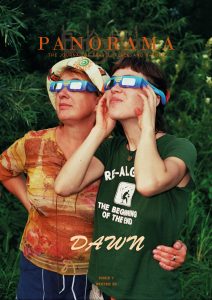
Decolonising Travel Senior Editor Faith Adiele sat down with Shaul Bassi, Italian co-author of African Venice: A Guide to Art, Culture and People, the first guidebook to the extensive historical and contemporary African presence in Venice. Their discussion is interwoven with excerpts from this groundbreaking travelogue, which is organised into 10 walking itineraries, each illustrated with maps and art, and accompanied by essays, poems, and reflections, many penned by major African and Afro-descendant writers.
1.
Faith Adiele: Congratulations on completing such an important and innovative project! It’s a brilliant idea, and the collaboration with prominent Black voices is on point. What makes Venice the ideal site for such a project? Is it, as Igiaba Scego—Italy’s best-known African writer—puts it in her Foreword, that Venice’s rich travel history makes “the city intimately linked to Blackness”? Or could this same approach be taken to other Italian cities as well?
Shaul Bassi: Venice is the ideal site because, as art historian Paul Kaplan, the main author of this book, explains so eloquently, the city offers an unparalleled repertory of African figures. Black people appear everywhere, and if many other European cities have concealed their black history, Venice seems to have made a point to showcase it as a way to celebrate its own cosmopolitanism. This means mostly portraying servants and slaves, but not only that. And what is more, this rich visual archive has become, in the 20th and 21st centuries, a great source of inspiration for black artists and writers keen to revisit this unique heritage.
Venice must be stripped of all romanticism (especially the cheap version of it) and seen as it was: a geopolitical player that until its decline in the 18th century played a central role as a Mediterranean power. A city of commerce, of riches, of intrigue, of courts, of trade with the East and the Global South. Venice, which as early as the 15th century was what New York or Shanghai are today, that is, a centre of plurality, of crossbreeding, of grinding power, but also a key for the future.
Today a Black person arriving for the first time in Venice will experience the estrangement typical of someone who has never seen the lagoon, but will also realize that the city is intimately linked to Blackness. Venice, like Livorno, like Trapani, like Naples, like Messina, like Rome, is in fact linked to what historians such as Salvatore Bono and Giovanna Fiume have defined as “Mediterranean slavery.” Many people, not only Black, especially those from Anatolia and North Africa, were enslaved in Europe, in Portugal and Spain, but also in Sicily and Campania, Tuscany and Veneto. Slavery followed the caravan and slave routes traced by ancient African kingdoms and Arab traders; the Portuguese were the main driver of the Atlantic trade (and the link that created the nefarious connection Blackness-goods-slavery) and the leap from Lisbon to the whole of Europe was a straight one.
—Igiaba Scego, Foreword
2.
FA: Another thing that makes African Venice so important is the inclusion of the current African presence, in particular, immigrants. Rarely, if ever, do travelogues pay attention to immigrants, migrants, and non-leisure travellers—especially Black ones—and yet my strongest memories of Venice are the Senegalese street vendors I spent my time with until shouts of La polizia! had them snatching up the edges of the cloths upon which they displayed their wares, tossing the huge bundles over their shoulders like Christmas elves, and scattering in all directions down Venice’s countless alleyways. How did you approach correcting this absence from the literature and sourcing Black travel voices, including heartbreaking account of deaths and killings?
SB: Things change so fast. Today you are no longer likely to see the street vendors, because it is the one form of illegal activity that the municipality will not tolerate for cosmetic reasons (far more serious and consequential ones are turned a blind eye on …). At the same time Venice is more and more a city of migrants than it has been for most of its history. The almost all white, Italian city I grew up in in the 1970s was the exception rather than the rule. The new postcolonial, migration waves have reactivated the ancient vocation of Venice to include – often strategically, instrumentally – people from all other the world to boost the local economy. So our book is not just retrospective, it is open-ended, and shares both success stories of black migrants who have made it and tragic events related to victims of racism.
I arrived here as a migrant, on a barge, after crossing the desert and the terrible borders of many African countries. I was 16 when I left, but I had no choice. It was months of fear, pain, loneliness, violence on the body. As soon as I arrived in Italy, I wanted to tell everything in a book,
—Ibrahima Lö, “A Senegalese in Venice”
There is also no noise in Venice. And for a native of noisy Nairobi, to which I am a contributor with the loud rock music, the muffled silence of the picturesque courtyards can be disconcerting.
—Tony Mochama, “Death of the Last Venetian Mosquito”
So much of history passes through Venice. I have been thinking lately, however, about what my presence in contemporary Venice means. What it signifies to those African migrants and refugees who lock eyes with me in that temporary landscape that has no name, no boundary, but our skin. Often, I am the only one in the rush of tourists who looks at them, these young men who shield themselves from their own memories through defiance and hard work. I am usually the only one who pauses to nod or smile: I see you. Sometimes, a conversation begins. Other times, they turn, and I move on.
—Maaza Mengiste, “The Least of All Things: Afterword”
3.
FA: After a note on how to use the book, designed for both actual and armchair travellers, you include two contextualising essays. The first, by your American collaborator and co-author Paul Kaplan, provides an overview of Africans in Venetian history through famous artworks, while yours addresses the present. You open with lines from a poem about Venice written in Kikuyu by Kenyan intellectual giant Ngũgĩ wa Thiong’o, drawing connections between colonialism and recent African immigration, and talk about African artists travelling to Venice for both the Biennale and residency programs, the latter which “allow[s] a more immersive relationship between the artists and the city.” What are you trying to tell the reader about how the past and present Venice engage?
SB: It was the African American artist Fred Wilson, helped by Paul Kaplan, who in his groundbreaking Biennale exhibition in 2003, understood the potential of reinscribing the lives of the many fictional Black people of Venetian art in a contemporary perspective, informed by our modern sensibility and by a truly antiracist viewpoint. In simple terms, most of the Black from the past are objects of contemplation and curiosity, even if often endowed with enough expressiveness and vitality to make them individuals and not just stereotypes. The modern reimaginings, whether visual or literary, by contemporary Black artists and writers create a new subjectivity for them, enacting a true dialectical relationship between past and present, and showing how we don’t need to erase an unpalatable past of injustice as much as recontextualize it.
In 2010 the Angolan Kiluanji Kia Henda used the medium of photography to debunk some of the African clichés tenaciously persistent in Venice. His kaleidoscopic portrait The Merchant of Venice (2010) plays on the Shakespearean title to remind the viewer that the most conspicuous African presence in early 21st-century Venice was that of the street vendors, selling mostly cheaper fake replicas of luxury brand accessories and being persecuted with a zeal that was never applied to other illicit forms of commerce.
4.
FA: As a travel writer who is led by the senses, I particularly appreciated the wit behind the book design, with its interstitial sections evoking travel and sensory themes. Both “Coffee Break” and “The Scents of Africa” chart key trade routes between the African continent and Venice, and in your introduction, you point out that the itineraries “will also demonstrate how we unwittingly meet Africa in the fabric of Venice daily life: smelling fragrances coming from Morocco or Somalia, drinking coffee in what is usually conceived as a quintessentially Italian ritual, spotting unlikely plantain and palm trees…, brushing against types of stone that epitomise permanence but have actually travelled thousands of miles…” What can sensory travel do, and why was it important to take a coffee break?
SB: Thank you for appreciating our coffee break. When we started the book, we were well aware of the wealth of artistic sources and resources but had not given a serious thought to how much of Venice’s material culture is African. That was a true journey of discovery: who would imagine that many stones of Venice, to quote the title of John Ruskin’s canonical book, are from Africa? And we were very inspired when the wonderful writer Yvonne Adhiambo Owuor said she was interested in coffee, a quintessential Italian identity marker and a quintessentially African product. When we designed the book we asked: where would this go? And as a quip, I said that we needed a coffee break and the section ended up in the middle, also as a suggestion to have fun with this book.
Venice, it is rumoured, is the place where the first coffee house opened in Europe. It has evolved coffee cult distinct to itself. Venice, I see, will not yield its inner soul or secrets so easily. I am not here long enough to find its portals or let its confidences seep into me so I can find the site of Venice’s actual coffee-life origins. I am used to such places. I have a sense of awe for the places that are steeped in their own versions of life and make it a tad challenging for the contemporary stranger to barge their way in.
…There is a baffling need by a certain type of person to undermine if not completely erase the African-origins of anything good true or beautiful, including world’s favourite beverage, with all that it inspires. Every time this idea shows up, a platoon of naysayers also emerge with arguments to deny the reality, the still uncontested history of appropriation of coffee. It is the “Africa” part that gets them every time.
… Aromatics, Body, Tasting notes, Flavour profiles, Sweetness, Aftertaste. The world is compelled to speak wine language with coffee, that most desired and approved brand of Blackness.
—Yvonne Adhiambo Owuor, “Home Brew: Preliminary Tasting Notes”,
5.
FA: Let’s end with a meditation on water, an environmental crisis in both Venice and many nations in Africa. As Kaplan notes, it’s rather amazing that in one of the earliest guidebooks to Venice, published centuries ago in 1493, local guide Marino Sanuto reports that “many of the gondoliers of Venice were then Black Africans.” In his impassioned essay, “A Bridge Over the Chasm of Indifference,” Eritrean Italian journalist Vittorio Longhi notes the irony of so many African migrants drowning off Italy’s shores, which of course evokes the slave trade. He then attempts to leverage the symbol of the Venetian bridge to combat “the indifference of Venetian residents or tourists.” Mengiste refers to Venice as a city “built as much on myth as it is on water.” Besides printing the book’s covers on paper sourced from algae (what a clever response to the climate crisis in a water city!), what is the role of water in this walking investigation of Black Venice?
SB: The water of the sea made Venice rich through commerce; the water of the sea is now perceived as the ultimate threat to the city’s survival because of sea level rise. Today the sea is seen as an enemy also by those who propagate the myth of a migrant invasion coming from the Mediterranean. We celebrate the waters as connectors, as a public good that needs to be preserved both as a unique lagoon ecosystem and as a ‘blue humanities’ knowledge that can teach important lessons about climate change and adaptation all over the world. Carpaccio’s Black gondolier or Bellini’s Black diver can be seen as powerful symbol of a balanced relationship with the water, an amphibian existence based on the knowledge and respect of a city that has existed for centuries in a delicate balance between land and seas.
Finally, there could be no city in which the element of the bridge is equally evocative, the element that allows us a new connection between the two continents, between the two belongings, between the past and the present of a relationship that must never again be colonial. On those bridges we want to elevate the voices coming from Africa today, multiple and revolutionary, we want to amplify them and ensure their visibility in the European public sphere. We want them to no longer fall into the abyss of indifference,
—Vittorio Longhi, “A Bridge Over the Chasm of Indifference”
And then you find yourself at the end. The journey is done. The impulse at this point is to look back and make meaning of it all. To try to understand the knowledge gained and use it to sustain the years that will unfold. What Venice means might be different now, and if it is true that we remember most vividly those things that we see, then I wonder what it means to see African Venice. How does this reshape our understanding of this city that is built as much on myth as it is on water?
—Maaza Mengiste, “The Least of All Things: Afterword”
Extracts from African Venice: A Guide to Art, Culture and People, edited by Paul Kaplan and Shaul Bassi, Venezia: wetlands, 2024, www.wetlandsbooks.com
wetlands is a carbon-neutral project with a local production chain: all books are composed, produced and printed in Venice, on sustainable paper, by local labor. The covers are printed on paper sourced from algae.