Matthew Webb: Please could we start by talking about where these images were taken and what brought you there?
Arturo Rodríguez: The images were taken on La Palma, an island in the Canary Islands, Spain, where I was born. I don’t live there anymore, but most of my family, including my mom, still does. This is why my connection to the place is so strong.
Webb: There’s an awe-inspiring feeling of another world in your images. How did it feel to be there? How would you describe the environment and atmosphere?
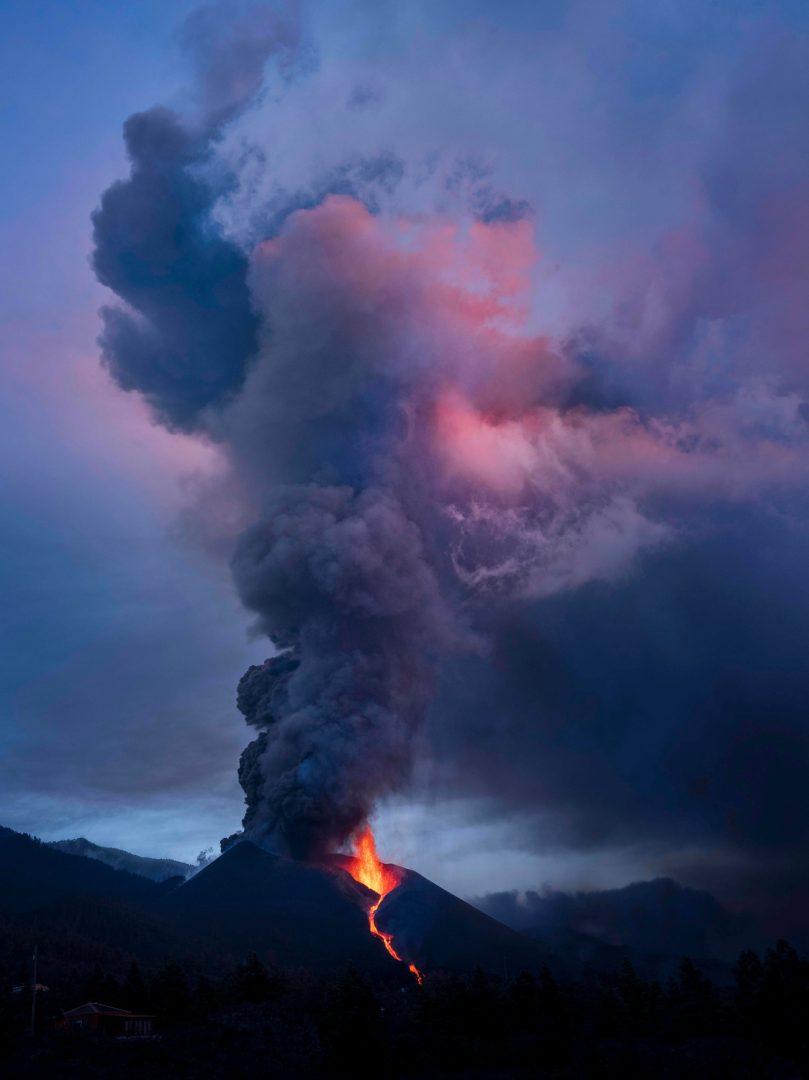
Rodríguez: Being in front of a volcanic eruption, from the perspective of someone who hasn’t been there, might seem like standing on an alien planet. But, of course, this is our beloved, precious, and wild Earth showing us its most brutal side. My feelings in that moment were of awe, witnessing live how the islands where I was born are formed—how life itself on Earth begins, because that’s what volcanoes are: destroyers and creators of life. You feel very small and powerless, yet at the same time, if you manage to distance yourself from the dramatic aspect, you feel incredibly privileged to witness such an extraordinary natural spectacle.
Webb: Is there mythology or folklore that speaks to the volcano on the island and how people relate to it?
Rodríguez: The Canary Islands were conquered by Spain in the 15th century, and almost every trace of the indigenous people who lived here was erased from history by the Church. However, according to historical accounts, they believed the volcanoes were the dwelling place of evil. At the same time, the islands’ original inhabitants used everything the volcano provided for their benefit—like obsidian crystals to make knives and axes. They also used volcanic tubes as shelters or burial sites.
Webb: Your images bring the viewer very close compared to other images I’ve seen of the eruption. How close were you? What protective clothing, equipment, and planning were required?
Rodríguez: Well, on the luckiest days, just a few meters away from the lava flows. You have to keep in mind that the lava is so hot the air rises very quickly, so you are relatively safe as long as there are no strong winds pushing the heat back toward you, which could kill you in a matter of seconds. It’s less dangerous than we might imagine, especially if you’re with experienced people like the scientists from IGME (Geological and Mining Institute of Spain), with whom I usually work. Of course, you need heat-resistant clothing and shoes, a helmet, a gas mask, detectors, and to follow certain rules related to wind direction, as well as making sure you park your car in a way that doesn’t block emergency exit routes. The most important thing is following the rules and using a bit of common sense.
Webb: How important is it to be within the environment rather than looking from a distance? What do you gain by being in situ and not setting a camera trap?
Rodríguez: Robert Capa’s most famous quote says, ‘If your pictures aren’t good enough, you aren’t close enough.’ And yes, a camera trap can be a good choice in many cases, especially with wild animals, but in the case of wild landscapes, being there gives you the opportunity to react, rethink, reframe, and succeed. However, it’s always a good idea to work as a team with someone who is constantly monitoring the situation.
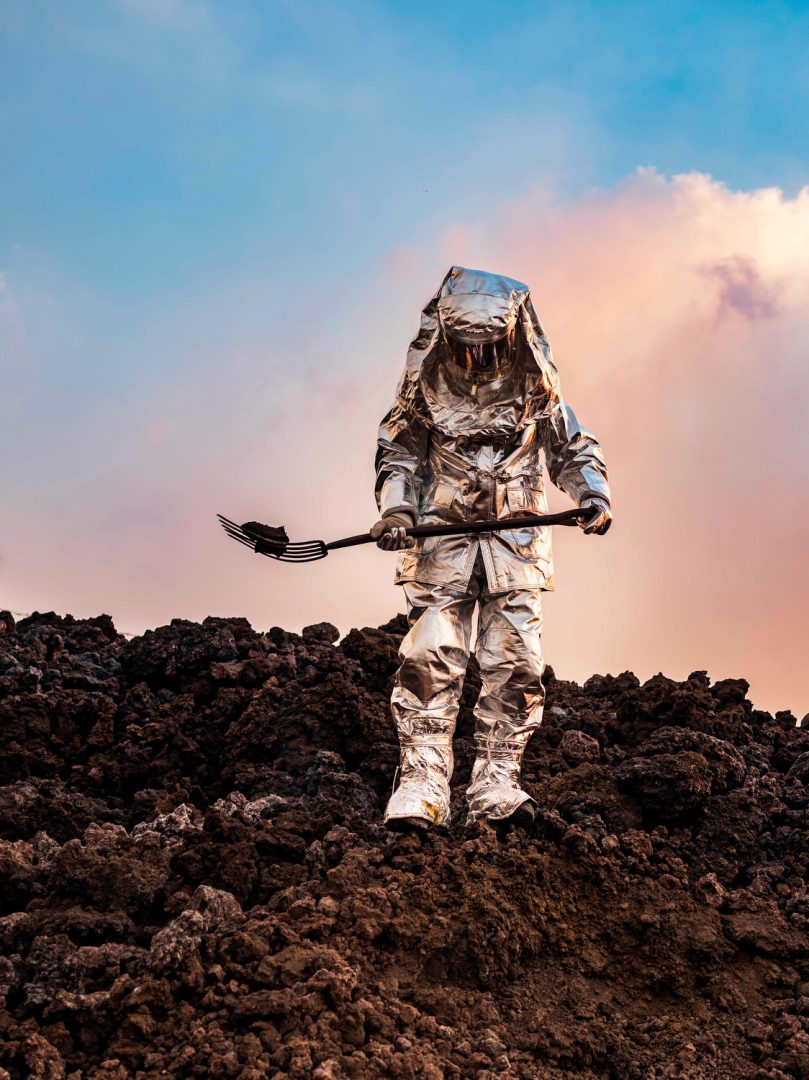
Webb: Who were the people in the reflective, protective suits? What were they doing? Was their work part of studies/experiments that are only possible during or after a volcanic happening or is this part of a long-term project?
Rodríguez: Brigadier Armando Salazar and Corporal Alvaro Heredia from Spain’s Military Emergency Unit were the individuals in silver suits. The Ministry of Defense has an agreement with Spain’s Mining and Geological Institute to assist scientists in situations like volcanic eruptions, where the military provides both the necessary equipment and physical conditioning. They are helping scientists collect samples of fresh lava, which requires these specialized suits. As lava cools, it loses many substances—especially gases—that scientists aim to analyze.
Webb: What did you and the team around you learn from the expedition? What dangers did you face?
Rodríguez: There is actually a lot to consider. When it comes to volcanoes, keep in mind that there are few opportunities to analyze, experiment with, measure, and observe them. Although volcanic eruptions are happening around the world, few have the unique characteristics of the one in La Palma. It was an urban eruption where lava interacted with civil infrastructure, encountering vehicles, homes, and even gas stations. The lava reached the ocean, allowing real-time observation of its effects on marine life. Scientists could measure the impact on local reptiles, birds, and pine forests.
This all took place on a Spanish island with low crime rates, a hospital within 30 minutes in case of accidents, an international airport with daily connections, and a country with scientific collaboration agreements with major global powers like the USA, UK, and Germany. For 85 days, La Palma became the largest open-air laboratory in the world, with over 1,000 scientists from around the globe working on various projects. They studied life under extreme conditions, seismic activity, surface deformation via satellite, fluid dynamics in lava rivers, and, above all, devoted significant effort to predicting when and where the next eruption might occur, using a multitude of techniques.
Webb: The Canary Islands are a popular tourist destination. How were the local people and holidaymakers affected by the eruption and how long did it last?
Rodríguez: Regarding tourism, the first month was terrible, but after that, everything returned to normal—perhaps even better. People are fascinated by volcanoes; it’s something deeply rooted in us, something primal, I guess.
On the other hand, the local population suffered immense losses. Around 80,000 people live in La Palma, and the Tajogaite eruption destroyed around 7,000 buildings—imagine that. Some people are still living in shipping containers, but that’s not the worst of it. Mental health issues and suicide rates have surged on the island in recent years. Think about it: there are people who haven’t just lost their homes, but their entire villages—the church where they got married, the bench in the square where they had their first kiss, the school they attended. Now there’s just a wall of black rock, in some places up to 30 meters high.
The inept government we have can’t even agree on basics like education or healthcare, so you can imagine the outlook for these people. There are still people living in emergency housing built after the 2011 earthquake in Lorca, Murcia. So, I don’t expect anything better for my fellow citizens.
Webb: It’s wonderful that you’re making affordable prints available of your images. How important is it that people support your work and where is the best place to buy them?
Rodríguez: Offering affordable prints is an important part of my diversification strategy. Nowadays, diversifying is the best way to make a living from photography. By offering prints at various price points, I can reach a broader audience while sustaining my work. People who support my photography not only help keep the craft alive but also enable me to take on personal projects. For example, the sales of my images allowed me to cover the eruption, a project that required me to put everything else on hold for almost three months. The best place to purchase my work is through my website at arturorguez.com, where you can explore the collection and choose pieces that resonate with you.